How to Read Colocation Contracts for GPU Clusters
A colocation (colo) contract grants you a license to put your servers in someone else's building. It is not a lease, and the colo provider is strictly not a landlord. The contract comes with powerful options for the colo provider. It allows the provider to raise your power rate, it allows the provider to cap its own liability, and it allows the provider to take your servers if you fail to pay on time. Terms like these are standard across the industry.
This article is based on colo master service agreements (MSAs) we've reviewed from private deals. [1]Based on review of private colocation master service agreements (MSAs) from multiple U.S. data center providers
A colo agreement is a license, not a lease
A colo contract explicitly disclaims any landlord-tenant relationship. The contracts we've reviewed state that the agreement is a services contract, not a lease of real property, and that the customer is a licensee, not a tenant. [1]Based on review of private colocation master service agreements (MSAs) from multiple U.S. data center providers
The service order form attached to the colo contract itemizes exactly what you're buying: the number of cabinets or cages, the power commitment in kW per rack, the internet bandwidth allocation in Mbps, cross-connect circuits, and environmental targets like temperature and humidity ranges (typically following ASHRAE guidelines). [2]ASHRAE Technical Committee 9.9, "Thermal Guidelines for Data Processing Environments" (2021)https://www.ashrae.org/technical-resources/bookstore/datacom-series It also covers access procedures, remote hands rates, and any installation or non-recurring charges for racks, electrical circuits, and cabling.
It's important to understand why providers make sure you're not considered a tenant. A tenant gets several protections. Your rights would include restrictions on the landlord entering your space and protections against eviction. A licensee gets none of these.
| As a colo licensee | As a tenant | |
|---|---|---|
| Provider enters your space | They can enter at any time for maintenance, or any reason | They are restricted from entering |
| Provider wants to move your equipment | They can move it with five days’ notice, or none at all | They cannnot touch your property without your consent |
| Provider wants you out | They can revoke the license per contract terms | They have to follow a formal eviction process required by law; courts involved |
| Dispute over facility conditions | You are limited to the remedies listed in the contract | You have statutory protections: right to withhold rent, right to repair and deduct |
For example, this distinction could be important if you have sensitive equipment that can't be moved. The colo provider, as a licensor and not a landlord, retains the right to enter your space at any time for maintenance and inspections. It can also relocate your equipment when doing so. Some contracts reserve this right with no advance notice requirement, as long as the replacement space is similar in size and configuration. Others require five calendar days' written notice. [1]Based on review of private colocation master service agreements (MSAs) from multiple U.S. data center providers
How power pricing works
Power is the single largest recurring cost in a GPU colo deployment. A dense GPU rack can pull 40kW or more.
Colo contracts price power per kW per month, but the rate you sign at isn't always the rate you'll pay for the full term. Contracts include escalation mechanisms that make pricing dynamic: if the colo provider's own energy costs rise, they can pass those increases on to you.
The Consumer Price Index (CPI), a government-published measure of how fast everyday prices are rising across the economy, is sometimes used as the baseline for these adjustments. We've seen contracts that allow a CPI + 2% rate increase after the first 12 months, meaning your costs can climb even if electricity prices stay flat. [1]Based on review of private colocation master service agreements (MSAs) from multiple U.S. data center providers
On top of that, most contracts include electricity cost pass-throughs, allowing the provider to raise your rate at any time if their utility costs increase. Others use a threshold model, passing through any power cost increase above a fixed cap, typically 2%. [1]Based on review of private colocation master service agreements (MSAs) from multiple U.S. data center providers
At scale, these clauses matter. If you're paying $150/kW/month for 2MW of committed power, your monthly bill is $300,000. A 10% power cost increase passed through adds $30,000/month, $360,000/year.
Most contracts monitor consumption at 5-minute intervals. If your peak usage exceeds your committed power level, overage charges apply per kW at the contracted rate. Some contracts also ratchet up (auto-increase) your committed level automatically when overages exceed 10% of your commitment in a given month. The bill goes up but never comes back down. [1]Based on review of private colocation master service agreements (MSAs) from multiple U.S. data center providers
Contracts set circuit rating limits too. Typically, they provide A-B redundant power feeds or two separate sources of power for your servers. Your power consumption cannot exceed 80% of either feed's rating. Exceed this and the provider is not liable for any resulting outage. For GPU racks running at high density, this headroom constraint limits how much compute you pack per rack.
What SLA credits actually cover
Colo providers advertise near 100% uptime targets. The service level agreement (SLA) tells you what happens when they miss those targets.
Credit formulas can vary. One common structure: one hour of the monthly fee credited per 15 minutes of downtime on the affected circuit. Another: one day of the monthly fee credited per hour of outage. The difference between these two formulas is roughly 6x for the same event, yet both seem similar at first glance. [1]Based on review of private colocation master service agreements (MSAs) from multiple U.S. data center providers
All contracts we've reviewed cap total credits at 100% of the monthly fee for the affected service. Credits don't carry over month to month, so make sure to make the claim and apply the credits on time. [1]Based on review of private colocation master service agreements (MSAs) from multiple U.S. data center providers
| SLA term | What to look for |
|---|---|
| Credit formula | Per-hour or per-15-min increments; one day of credit per hour of outage is generous, one hour of credit per 15 min of outage isn't |
| Maximum credit | Typically 100% of monthly fee for the affected circuit or service |
| Claim deadline | 1-10 business days to open a ticket or submit written notice; miss the window and you forfeit the credit |
| Excluded events | Force majeure, scheduled maintenance, customer-caused incidents, and sometimes accounts that are past due |
Ultimately, the SLA credit is always a fraction of the interruption's business cost. If you have a 4-hour interruption, you might be breaching your own SLAs to customer downstream, or leaving GPUs unable to serve inference to customers.
When optimizing your choice of colo, choose low downtime over better credits. Talk to existing customers to get a sense of downtime and reliability in that location.
The provider's liability is capped
Most colo contracts we've reviewed cap the provider's total liability at the fees paid in the three months before the incident. [1]Based on review of private colocation master service agreements (MSAs) from multiple U.S. data center providers
If you're paying $300,000/month, and it's been three months into the contract period, the cap is $900,000. Your hardware in the facility might be worth $25M.
The contracts also exclude consequential damages: lost revenue, lost profits, lost data, lost customers.
Services are provided on an as-is basis with no guarantees that it's suitable for your use case. Some contracts go further, explicitly including an "all faults" disclaimer. These are standard across the industry. [1]Based on review of private colocation master service agreements (MSAs) from multiple U.S. data center providers
Your exposed surface area for risk is the cost of your hardware and lost revenue. The provider's liability to you is only three months of your bill. The difference between the two is yours to manage through insurance, redundancy, or negotiated terms.
Insurance requirements
Colo contracts require the customer to carry insurance before equipment enters the facility. The provider won't insure your hardware. Any insurance the provider carries covers its own building and infrastructure, not your servers. As mentioned above, the provider's liability is often capped at three months of your bill. [1]Based on review of private colocation master service agreements (MSAs) from multiple U.S. data center providers If you need the policy placed, American Compute brokers GPU property insurance for equipment in colocation facilities.
But a requirement is not the same as enforcement. Providers rarely verify that you actually purchased the policies or that coverage stayed current after move-in.
The insurance clause serves the provider primarily as a liability shield: by requiring you to carry coverage, the provider shifts the financial risk of equipment loss, damage, or third-party claims entirely to you and your insurer. If something goes wrong and you don't have the required insurance, the provider points to the contract clause and walks away. The requirement protects them, not just you.
Here are the typical insurance requirements for colo contracts: [1]Based on review of private colocation master service agreements (MSAs) from multiple U.S. data center providers
- Commercial General Liability (CGL): $1M per occurrence, sometimes with an additional $1M aggregate umbrella. Covers bodily injury and property damage claims; so if your hardware damages the provider's building or another customer's servers, your insurance will cover the cost of the damage.
- Property Insurance: Covers your equipment at full replacement cost value, and typically required to be on a "All-risk" basis. This means it's protected from fire, theft, water damage, natural disasters (unless excluded), and other perils. Some insurance policies also cover the loss of data.
- Workers' Compensation: Statutory limits for the state where the facility is located, plus Employer's Liability at $1M. Typically required by State Law, the colo wants to make sure if your technicians are injured while installing the servers, you have insurance in place.
- If you use contractors for installation or maintenance work in the facility, most colo contracts require contractors to carry the same insurance minimums and provide their own certificates before any work begins.
Several additional conditions are common. The provider is typically named as an additional insured on your policies. Your insurance must be primary, meaning the provider's own insurance only pays (if at all) after yours. Policies cannot be canceled or modified without giving the colo provider 30 days' advance written notice. And the insurer must waive subrogation rights against the provider, meaning your insurer can't sue the provider to recover a loss it paid on your behalf. [1]Based on review of private colocation master service agreements (MSAs) from multiple U.S. data center providers
Property insurance and replacement cost
Most contracts require your property insurance to cover "replacement cost", or what it would cost to replace your hardware with something similar.
But you might not need the full coverage on the second or third year of the contract. You can ask your insurer to adjust coverage each year to match current market prices for used servers. A GPU server that cost $100,000 new might be worth $50,000 in early 2026. The lowered coverage will translate to insurance savings.
But be careful not to go too low. If used hardware prices spike (like during 2025's memory shortage), you might not have enough coverage to replace your damaged hardware.
Adjusting coverage: savings vs underinsurance risk
What happens when you leave or default
Early termination
If you terminate before the contract ends for any reason other than the provider's breach, all remaining monthly fees become due immediately. Some contracts explicitly frame this as liquidated damages. [1]Based on review of private colocation master service agreements (MSAs) from multiple U.S. data center providers
On a 3-year contract at $300,000/month with 18 months remaining, early termination costs $5.4M.
Auto-renewal compounds the risk. We've seen cancellation notice windows ranging from 30 to 60 days before term expiration. Miss the window on a 12-month contract and you're locked in for another full year. Miss it on a 36-month contract and you've committed to another 36 months. [1]Based on review of private colocation master service agreements (MSAs) from multiple U.S. data center providers
Equipment removal needs to be scheduled as well. Some contracts require customers with 10 or more cabinets to submit a detailed decommissioning plan at least 30 days before the termination period. Without it, the provider controls the move-out process and bills you at market rates.
What happens if you stop paying
If you fall behind on payments, the provider's remedies escalate fast.
Default escalation: missed payment to equipment sold
Some contracts in the U.S. grant the provider a "UCC Article 9 security interest" in all customer equipment in the facility. That means if you don't pay, the provider can lock you out, change access codes, take your equipment, delete your data without retaining copies, and sell the hardware to recover what you owe. [5]Uniform Commercial Code, Article 9 — Secured Transactionshttps://www.law.cornell.edu/ucc/9
Depending on the contract, there may be a more structured timeline and process to it. For example, it might specify that after the termination period, the provider cuts power, changes locks, and revokes access. Seven days later, it can move your equipment. Fourteen days later, it can sell everything through a public or private sale.
The worst version of this clause: the provider retains all sale proceeds and the customer waives any claims under any legal theory. For a GPU deployment, the equipment value exceeds the outstanding fees. A provider that sells a $25M GPU cluster to recover $900K in unpaid bills keeps the surplus under these terms. [1]Based on review of private colocation master service agreements (MSAs) from multiple U.S. data center providers
What to negotiate before signing
Standard colo contracts are templates. Providers accept negotiation on larger deployments. The template is only their opening position.
Here's what the providers want to see for you to get preferential terms. They want a creditworthy customer who will pay on time. Can you give them confidence by showing your financials, your funding, multi-decade history as a well-sized enterprise, your expected revenues (any offtake agreements), previous colo payments you've made on time? Are you expecting to grow in size and do more business with them? Do you come recommended by an existing trusted customer of theirs?
Additionally, you can always use competition. Get offers from other colos, and ask the provider to "match the market terms" and reference another colo contract, or this article.
Here are some things you might want to negotiate:
- Power rate caps. Fix the rate for the initial term, or cap annual increases at a specific percentage. Open-ended pass-through language gives the provider unlimited pricing authority.
- Security interest scope. Push for automatic lien release when the account is current, and that there'll be return of surplus proceeds to the customer.
- Shorter cancellation notice window. Shorten the required notice window from 30-60 days to 14 days, to have more time to shop before opting out of auto-renewal.
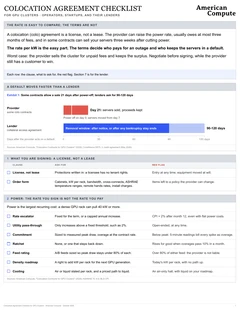
This article as a three-page checklist: 32 clauses from power to default, each with what to ask for and the red flag, plus the collateral access clauses your lender will ask for.
References
- Based on review of private colocation master service agreements (MSAs) from multiple U.S. data center providers
- ASHRAE Technical Committee 9.9, "Thermal Guidelines for Data Processing Environments" (2021)
- U.S. Bureau of Labor Statistics, "Consumer Price Index — All Urban Consumers" (accessed March 2026)
- Electric Reliability Council of Texas (ERCOT), wholesale electricity market data (accessed March 2026)
- Uniform Commercial Code, Article 9 — Secured Transactions
Frequently Asked Questions
Can a colocation provider take your GPU servers?
Yes. Standard colocation contracts in the U.S. grant the provider a security interest in customer equipment under UCC Article 9. If you default on payments, the provider can lock you out, remove your equipment, and sell it. Some providers retain all sale proceeds regardless of the equipment's value relative to the outstanding debt.
What is a colocation SLA credit?
An SLA credit is a partial refund of your monthly hosting fee for downtime caused by the provider. Credits are calculated per unit of downtime (typically 1 hour of fees per 15 minutes of outage, or 1 day of fees per hour) and capped at 100% of the monthly fee for the affected service. SLA credits do not cover lost revenue, failed training runs, or downstream contract breaches.
How much notice to cancel a colocation contract?
Standard colocation contracts require 30 to 60 days' written notice before the end of the current term. If you miss the notice window, the contract auto-renews for a period equal to the initial term. Terminating mid-term triggers an early termination fee equal to all remaining monthly fees for the rest of the contract.
What is the liability cap in a colocation contract?
Standard colocation contracts cap the provider's total liability (ie. money they owe you) at the fees paid in the preceding three months. The contract also excludes consequential damages: lost revenue, lost profits, lost data, and lost customers. For a GPU deployment where hardware alone may be worth $25M+, the gap between the liability cap and actual exposure can be tens of millions of dollars.
We source vetted data center compute deals for funders, with added downside protection for credit, collateral, and operational risks.
Discuss a transaction →