GPU Finance Glossary
The terms lenders, lessors and operators meet in GPU deals, from advance rate to utilization.
120 terms
#
- $1 buyout leaseCredit & structure
- A $1 buyout lease transfers the equipment to the lessee at the end of the term for a nominal price. Rent recovers the full cost, so economically it is a loan and the lessee keeps the residual risk.
A
- Advance rateCredit & structure
- The advance rate is the share of the collateral’s value, or of the equipment cost, that a lender will lend. A 70% advance rate on $10M of GPU servers means a $7M loan and $3M of borrower equity.
- AI factoryData center & power
- AI factory is NVIDIA’s term for a data center built to produce AI output, tokens, at scale: GPU systems, networking, power and cooling designed as one plant rather than general-purpose IT.See What is an AI factory
- All-risk property insuranceInsurance & risk
- All-risk property insurance covers physical loss or damage to insured property from any cause not specifically excluded. For GPU servers it is the core policy against fire, water, theft and power events at the data center.See GPU property insurance · Insuring a GPU cluster
- AM Best ratingInsurance & risk
- An AM Best Financial Strength Rating is AM Best’s opinion of an insurer’s ability to meet its ongoing obligations to policyholders, on a scale from A++ (Superior) to D (Poor). A and A- are rated Excellent.See How a residual value floor works · Insuring a GPU cluster
- AmortizationCredit & structure
- Amortization is the repayment of a loan’s principal through scheduled payments over its term. GPU loans typically amortize 25-30% a year, matched to how fast the hardware loses value.See Private credit and ABS in GPU financing
- Asset-backed securities (ABS)Credit & structure
- Asset-backed securities (ABS) are bonds paid from the cash flows of a specific pool of assets, such as leases or loans, rather than from the issuer’s general credit. The pool is split into tranches that take losses in reverse order of seniority.See Private credit and ABS in GPU financing · GPU Financing Tracker
B
- Backup servicerCredit & structure
- A backup servicer is a party contracted to take over collecting payments and administering a pool of loans or leases if the primary servicer fails. In GPU finance, the equivalent role extends to running the hardware: a backup operator.See Backup Operator (Step-in Rights) · Compute offtake agreements
- Balloon paymentCredit & structure
- A balloon payment is a lump sum due at the end of a loan because the regular payments did not fully pay it off. On a GPU loan, the balloon is usually repaid by selling or refinancing the hardware.See How a residual value floor works · GPU Residual Value Report 2026
- Bare metalData center & power
- Bare metal means renting a physical server with no virtualization layer between the customer’s workload and the hardware. Large compute offtake contracts are often for bare metal environments.See Bare metal for AI compute
- Behind-the-meter powerData center & power
- Behind-the-meter power is electricity generated on or next to the site and used there without passing through the utility’s meter or the public grid, for example on-site gas turbines or a data center beside a power plant.See Natural gas for data centers · How power reaches an AI data center
- Bill of materials (BOM)Hardware
- A bill of materials (BOM) is the itemized list of equipment and services used to price and deliver a GPU cluster: servers, GPUs, networking, storage, racks, cabling, installation and support, with quantities and prices.
- BlackwellHardware
- Blackwell is NVIDIA’s GPU architecture after Hopper, sold as the B200, the higher-clocked B300 (Blackwell Ultra) and the Grace Blackwell GB200 and GB300 superchips used in NVL72 racks.See NVIDIA GPU generations
- Booked residualInsurance & risk
- The booked residual is the end-of-term value a lessor assumes when it prices a lease. Overbooking means assuming more than the equipment will fetch: it lowers the rent and wins the deal, and the loss arrives at lease end.See GPU Residual Value Report 2026
- Bridge loanCredit & structure
- A bridge loan is short-term financing repaid from a later, larger financing. In GPU deals, a bridge lender can pay for hardware in the roughly 90 days between payment and installation, then be repaid by the term lender once servers are racked.See How to finance a GPU cluster · Refinance a GPU cluster (gpulenders.com)
- Burn-in testingHardware
- Burn-in testing runs new or refurbished servers under sustained full load, typically for 24-72 hours, to surface early failures before the hardware goes into production or is accepted by the buyer.See When a GPU dies in production · Where to buy GPU servers
- Business interruption insuranceInsurance & risk
- Business interruption insurance pays lost income and continuing expenses after physical damage to insured property stops operations. It responds to damage at the insured site, not to a customer that stops paying.Colocation and compute contracts usually exclude consequential damages such as lost revenue, so the provider will not cover it.See Insuring a GPU cluster
C
- Capex and opexMarket & pricing
- Capex (capital expenditure) is the upfront cost of the hardware and its installation; opex (operating expenditure) is the recurring cost to run it: power, colocation, staff, insurance. GPU servers are 85-90% of a cluster’s capex in our model.See AI cluster cost breakdown: capex · AI cluster opex, TCO and payback
- Cash sweepCredit & structure
- A cash sweep requires the borrower to use some or all excess cash flow to prepay debt instead of distributing it, often only after a trigger such as a falling DSCR or an expiring offtake contract.See Neocloud Credit Score
- Change of controlContracts
- A change-of-control clause gives a party rights, often to terminate, if the other party is acquired. Compute contracts commonly let either side terminate if the other is bought by a direct competitor.See Compute offtake agreements
- Coinsurance clauseInsurance & risk
- A coinsurance clause requires insuring at least a set share of total replacement value, typically 80%. Insure below it and the insurer reduces every claim payment proportionally, even small ones.See Insuring a GPU cluster
- Collateral access agreementContracts
- A collateral access agreement, or landlord waiver, is an agreement in which the owner of the premises where collateral sits, such as a colocation provider, waives or subordinates its own claims to the equipment and lets the lender enter to remove it.See Colocation contracts for GPU clusters · Backup Operator (Step-in Rights)
- Collateral assignment of contractsContracts
- A collateral assignment of contracts transfers the borrower’s rights to payment under its key contracts, such as compute offtake agreements, to the lender as security, so the lender can collect the revenue or transfer the contract after a default.See Compute offtake agreements · How to finance a GPU cluster
- ColocationData center & power
- Colocation (colo) is renting space, power, cooling and connectivity in a third-party data center for servers you own. The colo provider runs the building; the customer owns and operates the equipment.See Colocation contracts for GPU clusters · GPU colocation (managedgpus.com)
- Colocation agreementContracts
- A colocation agreement grants a customer a license to place its servers in a provider’s data center and buy power, cooling, space and connectivity there. It is typically a services contract, not a lease of real property.See Colocation contracts for GPU clusters · GPU colocation (managedgpus.com)
- Consequential damages waiverContracts
- A consequential damages waiver excludes indirect losses, such as lost revenue, lost profits and business interruption, from what one party can recover from the other. Compute and colocation contracts almost always include one.See Compute offtake agreements · Colocation contracts for GPU clusters
- CovenantCredit & structure
- A covenant is a promise in a credit agreement that the borrower will do, or not do, something, such as keep DSCR above 1.3x or use loan proceeds only for hardware. Breaching one is an event of default.GPU loan covenants commonly bar using loan proceeds for salaries, admin or software, since those produce no seizable collateral.See How to finance a GPU cluster
- Critical IT loadData center & power
- Critical IT load is the power drawn by the computing equipment itself, servers, storage and network, as opposed to the facility’s total draw including cooling and losses. Data center capacity is usually quoted in MW of critical IT load.See How power reaches an AI data center · The power budget of an AI data center
- Cure periodContracts
- A cure period is the time a party gets to fix a breach after notice before the other side can terminate or enforce. Compute contracts typically allow 30 to 45 days for material breach and non-payment.See Compute offtake agreements
- Customer concentrationInsurance & risk
- Customer concentration is the share of a borrower’s revenue that comes from its largest customers. In smaller GPU financings, one customer above 40% of revenue is a yellow flag.Some compute buyers impose the mirror image: a cap on the share of an operator’s capacity any one customer can take.See Offtake Tracker: public compute contracts · How to finance a GPU cluster
D
- Debt service coverage ratio (DSCR)Credit & structure
- The debt service coverage ratio (DSCR) is cash flow available for debt service divided by the principal and interest due in the same period. A DSCR of 1.3x means the borrower earns $1.30 for every $1.00 it owes the lender.
- Debt service reserve account (DSRA)Credit & structure
- A debt service reserve account (DSRA) holds cash, typically 3-6 months of principal and interest, that the lender can draw if operating cash flow falls short.Our Neocloud Credit Score lists 3-6 months of debt service held in reserve as typical structure for an AC-3 borrower.See Neocloud Credit Score
- Delayed draw term loan (DDTL)Credit & structure
- A delayed draw term loan (DDTL) is a term loan the borrower draws in pieces over an availability period instead of all at closing. In GPU finance, each draw usually funds a batch of servers as it arrives and is installed.
- Deposit account control agreement (DACA)Credit & structure
- A deposit account control agreement (DACA) is a three-party agreement between a borrower, its bank and the lender that gives the lender control over a deposit account. Under UCC Article 9, control is how a lender perfects a security interest in a deposit account.See Backup Operator (Step-in Rights) · Compute offtake agreements
- Depreciation curveMarket & pricing
- A depreciation curve plots an asset’s expected value over time as a share of its original cost. For GPUs, the market curve is steep and uneven, and differs from the straight-line depreciation used in tax and financial reporting.See GPU Residual Value Report 2026 · Rack Report
- DGXHardware
- DGX is NVIDIA’s own complete AI server, built on the same HGX baseboard as OEM servers but with a fixed CPU, memory, networking, software and support stack chosen by NVIDIA.See HGX vs DGX vs MGX
- Direct-to-chip liquid coolingHardware
- Direct-to-chip liquid cooling pumps coolant through cold plates mounted on the GPUs and CPUs, carrying heat away far more efficiently than air. Rack-scale Blackwell systems require it.See Liquid vs air cooling · The power budget of an AI data center
E
- EDP insuranceInsurance & risk
- EDP (electronic data processing) insurance covers computer equipment, often written on an inland marine form. Whether it is all-risk depends on the form, so check the form, not the label.Most insurers have no category for AI clusters yet; policies may list the business as crypto mining, which has similar equipment and risk profiles.See GPU property insurance · Insuring a GPU cluster
- Equipment financeCredit & structure
- Equipment finance is lending and leasing secured by the equipment being financed, provided by banks, captives and non-bank lessors. In GPU deals, operating leases come almost only from equipment finance lessors.See GPU financing (gpulenders.com)
- Equity contributionCredit & structure
- The equity contribution is the share of the project cost the borrower funds itself. It absorbs losses before the lender. In GPU deals it is commonly 20-40% of equipment cost, plus working capital to cover losses until the cluster is cash-flow positive.For a 1,024-GPU B200 cluster with $47M of capex at 70% LTV, our model puts hardware equity at about $15M and total cash to launch at about $16.5M.See How to finance a GPU cluster
- Event of defaultCredit & structure
- An event of default is a breach listed in the credit agreement, such as a missed payment, a covenant breach or the borrower’s insolvency, that lets the lender accelerate the loan and enforce on collateral. A cross-default clause makes a default on other debt a default here too.
F
- Fair market value (FMV) leaseCredit & structure
- A fair market value (FMV) lease is an equipment lease where the lessee can buy the equipment at the end of the term for its then fair market value, return it, or renew. Because the purchase price is not fixed, the lessor keeps the residual risk.See GPU Residual Value Report 2026 · How a residual value floor works
- Force majeureContracts
- A force majeure clause excuses or suspends performance when events beyond a party’s control, such as natural disasters, war or government action, prevent it. In compute contracts, some let the buyer terminate after 30 or more days; others say payment “may be delayed but is not excused”.See Compute offtake agreements
G
- GPU appraisalCredit & structure
- A GPU appraisal is a third-party estimate of what GPU servers and their components are worth today and at future dates, used to size a loan, book a lease residual or set insurance values.See GPU appraisals by generation · Appraisals & Due Diligence
- GPU price indexMarket & pricing
- A GPU price index tracks the price of a basket of GPUs over time against a base period. The Rack Report’s index tracks realized resale values, anchored to H1 2025 = 100; most other GPU indices track rental rates.See Rack Report
- GPU-backed loanCredit & structure
- A GPU-backed loan is a term loan secured by GPU servers and, usually, the compute contracts that pay for them. The lender files a lien on the hardware by serial number and takes an assignment of the offtake revenue.See GPU financing deals we reviewed · GPUs as collateral
- GPU-hourMarket & pricing
- A GPU-hour is one GPU running for one hour, the standard billing unit for GPU capacity. An 8-GPU server rented for a day is 192 GPU-hours.See Compute offtake agreements · AI cluster opex, TCO and payback
H
- HBM (high-bandwidth memory)Hardware
- High-bandwidth memory (HBM) is stacked DRAM packaged next to the GPU die. It sets how large a model a GPU can hold and how fast it can feed it: 80GB of HBM3 on the H100, 141GB of HBM3e on the H200.See Memory types for AI compute
- HGXHardware
- HGX is NVIDIA’s GPU baseboard: eight (or four) SXM GPUs wired together with NVLink and NVSwitch, which server makers such as Dell, Supermicro and HPE build complete servers around. An “HGX server” is the standard 8-GPU unit of AI compute.See GPU comparisons · HGX vs DGX vs MGX
- HopperHardware
- Hopper is the NVIDIA GPU architecture of the H100 (late 2022) and H200 (mid 2024). It dominated AI deployments in 2023 and 2024 and is now the most traded generation on the secondary market.
- HyperscalerData center & power
- A hyperscaler is one of the largest cloud and data center operators, such as Microsoft, Amazon, Google, Meta and Oracle. They fund AI capex mostly from operating cash flow and bonds, and are the strongest offtakers in GPU deals.See Who is building compute
I
- InfiniBandHardware
- InfiniBand is a low-latency network fabric, sold for AI by NVIDIA (Quantum switches, ConnectX adapters), that links GPU servers so they can train as one cluster. It supports RDMA, which lets one server read another’s memory directly.See GPU cluster networking · NICs and DPUs
- Interconnection queueData center & power
- The interconnection queue is the utility or grid operator’s process for studying and approving a new connection to the grid, for a power plant supplying electricity or a large load such as a data center consuming it.See How power reaches an AI data center · The modular data center opportunity
- Intercreditor agreementCredit & structure
- An intercreditor agreement sets the rights between lenders to the same borrower: who is paid first, who controls enforcement on the collateral, and what each may do after a default.
- IRR and MOICCredit & structure
- IRR is the annualized return that sets the present value of an investment’s cash flows to zero; MOIC is total cash returned divided by cash invested. GPU equity returns are sensitive to utilization and to the residual value at the end.At 80% utilization on a 1,024-GPU cluster, our model shows equity at roughly 2-3x MOIC over five years; at 70%, about break-even.See How to finance a GPU cluster
K
- kW per rack (rack density)Data center & power
- kW per rack is the electrical power a data center delivers to, and can cool in, a single rack. It sets how many GPU servers fit in each rack and which facilities can host them at all.See The power budget of an AI data center · Colocation contracts for GPU clusters
L
- Letter of creditContracts
- A standby letter of credit is a bank’s promise to pay a beneficiary on demand if its customer does not. A compute buyer can post one to secure its payment obligations; SharonAI’s MSA with ESDS requires $140 million in letters of credit or bank guarantees.See Compute offtake agreements
- Letter of intent (LOI)Contracts
- A letter of intent (LOI) sets out the main terms of a deal the parties expect to sign, usually without binding either to close. GPU projects gather LOIs from customers, lenders and investors before hardening them, because each waits on the others.See How to finance a GPU cluster
- Liability capContracts
- A liability cap limits the most one party can owe the other under a contract. Compute MSAs commonly cap general liability at six months of fees and data breaches at twelve; colocation contracts often cap the provider at three months.See Compute offtake agreements · Colocation contracts for GPU clusters
- Loan-to-value (LTV)Credit & structure
- Loan-to-value (LTV) is the loan balance divided by the value of the collateral securing it. A $7M loan against GPUs worth $10M has a 70% LTV.
- Loss payeeInsurance & risk
- A loss payee is a party named on a property policy to receive claim payments for damage to property it has a financial interest in, such as a lender or lessor of GPU servers.See GPU property insurance · Insuring a GPU cluster
- Lost revenue coverInsurance & risk
- Lost revenue cover is a surety bond, issued by an insurer for the lender’s benefit, that pays covered lost revenue through a qualifying offtake interruption while a replacement offtaker is found, for its coverage period and up to its limit.Not every offtaker departure qualifies. Terms are tailored to the offtake agreement and the financing.See Lost Revenue Cover
M
- Managing general agent (MGA)Insurance & risk
- A managing general agent (MGA) is an intermediary that an insurer authorizes to underwrite, price and sometimes bind policies on its behalf, within limits the insurer sets. The insurer, not the MGA, pays covered claims.
- Master services agreement (MSA)Contracts
- A master services agreement (MSA) is a framework contract that sets the legal terms for all future orders between two parties. Each purchase is then made on an order form or statement of work that adds quantities, prices and dates.See Compute offtake agreements · Colocation contracts for GPU clusters
- Mezzanine debtCredit & structure
- Mezzanine debt is a loan that ranks below senior debt and above equity. It is repaid after the senior lender and before shareholders, and is priced higher to match.See How to finance a GPU cluster
- Miner-to-AI conversionData center & power
- Miner-to-AI conversion is the retrofit of a bitcoin mining site, which already has power, into a data center for GPU servers, usually leased to a neocloud or hyperscaler as HPC hosting. Power is the asset; cooling, redundancy and networking usually need rebuilding.
- Modular data centerData center & power
- A modular data center is built from prefabricated power, cooling and IT modules assembled on site, so capacity can be placed wherever power is available and added in steps.McKinsey estimates prefabricated solutions cut delivery timelines by up to 50%.See The modular data center opportunity
N
- NeocloudData center & power
- A neocloud is a cloud provider built around renting GPU capacity for AI, rather than offering the broad range of services of a hyperscaler such as AWS, Azure or Google Cloud. CoreWeave, Nebius, Lambda, Crusoe and Nscale are the largest.See Neocloud Directory · The neocloud business model
- No-offset clauseContracts
- A no-offset clause requires the buyer to pay invoices in full and on time even while it disputes them, so a service complaint cannot become withheld payment. Lenders treat it as a key protection in an offtake contract.See Compute offtake agreements
- Non-recourse debtCredit & structure
- Non-recourse debt can be repaid only from the assets and cash flows that secure it; if those fall short, the lender cannot pursue the borrower’s other assets. Full-recourse debt lets the lender claim against the borrower, or a guarantor, for any shortfall.See Private credit and ABS in GPU financing · Neocloud Credit Score
- NVL72Hardware
- NVL72 is NVIDIA’s rack-scale system: 72 Blackwell GPUs and 36 Grace CPUs across 18 compute trays, joined by NVLink switches into one 72-GPU domain. GB200 NVL72 and GB300 NVL72 are sold as a whole liquid-cooled rack rather than as separate servers.See GPU comparisons · HGX vs DGX vs MGX
- NVLink and NVSwitchHardware
- NVLink is NVIDIA’s high-speed GPU-to-GPU interconnect; NVSwitch is the chip that connects every GPU to every other at full NVLink bandwidth. Without NVSwitch, NVLink links only neighboring GPUs.See NVLink and NVSwitch
O
- OEMHardware
- An OEM (original equipment manufacturer), such as Dell, HPE, Lenovo or Supermicro, builds and sells complete GPU servers under its own brand with its own warranty. An ODM builds to a buyer’s design, usually for hyperscalers.OEM warranties typically run three years. Our data shows Dell-built servers reselling about 18% above less-known OEMs.See Best OEMs for AI GPU servers
- OEM financingCredit & structure
- OEM financing is equipment financing from a server maker’s own finance arm, such as Dell Financial Services, HPE Financial Services, Cisco Capital or Lenovo Financial Services. The OEM can repossess, refurbish and resell its own hardware.See How to finance a GPU cluster
- Offtake agreementContracts
- A compute offtake agreement is a contract in which a customer commits to buy a defined amount of GPU capacity from an operator for a fixed term, usually as a master services agreement plus order forms that set the GPUs, price, term and payment schedule.
- OfftakerMarket & pricing
- An offtaker is the customer that commits to buy a cluster’s compute under an offtake agreement, such as a hyperscaler, an AI lab or an enterprise. Its payments are usually what repays the debt on the hardware.See Offtake Tracker: public compute contracts · Offtaker Credit Score
- Offtaker riskInsurance & risk
- Offtaker risk is the risk that the customer buying a cluster’s compute stops paying, terminates early or does not renew. In most GPU financings the offtake contract is the main source of repayment, so offtaker risk is the core credit risk.See Offtaker Credit Score · Lost Revenue Cover
- Orderly liquidation value (OLV)Credit & structure
- Orderly liquidation value (OLV) is the gross amount an asset would fetch in a sale with a reasonable time to find buyers, sold as-is, where-is. Forced liquidation value (FLV) assumes a quick sale, such as an auction, and is lower.See GPUs as collateral · Appraisals & Due Diligence
P
- Parent guaranteeCredit & structure
- A parent guarantee is a promise by the parent company to pay a subsidiary’s debt or contract obligations if the subsidiary does not. It turns SPV-level credit into parent-level credit.Offtakers use them too: a guarantee from an investment-grade parent can set a floor under a weak buyer’s score.See Offtaker Credit Score
- Payback periodMarket & pricing
- The payback period is how long an investment takes to return its initial cost from the cash it generates. For a GPU cluster it is usually measured on the equity, after debt service.See AI cluster opex, TCO and payback · Rack Report
- Payment waterfallCredit & structure
- A payment waterfall is the order in which a borrower’s cash is applied: typically taxes and operating costs, then interest, then principal, then reserves, and only then distributions to equity.See Backup Operator (Step-in Rights) · How to finance a GPU cluster
- PCIe GPUHardware
- A PCIe GPU is a card that plugs into a standard server slot and fits air-cooled servers, unlike SXM GPUs, which mount on an HGX baseboard. PCIe cards trade lower bandwidth between GPUs for flexibility and lower cost.See SXM vs PCIe
- Power usage effectiveness (PUE)Data center & power
- Power usage effectiveness (PUE) is total facility power divided by the power delivered to IT equipment. A PUE of 1.35 means the facility draws 35% more than the servers alone, for cooling and power distribution.See The power budget of an AI data center · AI cluster opex, TCO and payback
- Powered shellData center & power
- A powered shell is a building with utility power and basic structure in place but without the customer’s data hall fit-out: no cooling, power distribution or racks. The tenant or operator builds those.See The modular data center opportunity
- Prepayment (customer deposit)Contracts
- A prepayment is money the compute buyer pays before service starts, often a share of total contract value, credited against later invoices. It funds hardware and shows the buyer’s commitment.
- Price per million tokensMarket & pricing
- Price per million tokens is how inference providers sell model output: a list price for every million input or output tokens processed. It turns GPU-hours into a per-unit price for AI work.
- Private creditCredit & structure
- Private credit is lending by non-bank institutions, such as asset managers, private equity firms and specialty finance companies, negotiated directly with the borrower rather than syndicated by banks or sold as public bonds.See Private credit and ABS in GPU financing · GPU Financing Tracker
R
- Ready-for-service (RFS) dateContracts
- The ready-for-service (RFS) date is the date a facility, or the capacity in it, is handed over ready to run: power, cooling and network live. In GPU deals it also marks when servers can start earning under the offtake contract.See GPU deployment and schedule risk · How to underwrite AI infrastructure
- Realized priceMarket & pricing
- A realized price is what equipment actually sold for in a completed transaction, as opposed to an asking price, which is what a seller lists it at. For used GPUs the two can differ by more than 2x.See Rack Report
- Recovery rateInsurance & risk
- The recovery rate is the share of an exposure a lender gets back after a default, from collateral sales, contract proceeds and guarantees. Loss given default is the rest.For GPU loans, recovery depends on the residual value at default and on whether the offtake contract can move to a new operator.See GPUs as collateral
- Redundancy (N+1, 2N)Data center & power
- Redundancy is spare capacity that keeps a facility running when a component fails. N+1 means one spare beyond what the load needs; 2N means a complete second system that shares no components with the first.See Data center tiers
- RemarketingInsurance & risk
- Remarketing is selling or re-leasing equipment that comes back at the end of a lease or after a default. For GPU lessors and lenders, it is how a residual or a recovery is turned into cash.See Residual Value Insurance · Where to buy GPU servers
- Remote handsData center & power
- Remote hands are the colocation provider’s on-site staff, billed by the hour or in a monthly block, who rack servers, swap cables and replace failed parts so the customer does not need its own technicians on site.See AI cluster opex, TCO and payback
- Replacement costInsurance & risk
- Replacement cost is what it costs to buy equivalent new or like-kind property at the time of a loss. Actual cash value (ACV) is replacement cost minus depreciation, so it pays less.See Insuring a GPU cluster · GPU property insurance
- Reserved instanceMarket & pricing
- A reserved instance is GPU capacity a customer commits to for a fixed term at a set price, with exclusive access to specified hardware, paying whether or not it uses it. On-demand capacity has no commitment and is billed by the hour at published rates.See Compute offtake agreements · TCO: own vs rent GPU clusters
- Residual valueInsurance & risk
- Residual value is what an asset is worth at a future date, usually the end of a loan or lease term, expressed in dollars or as a percentage of its original cost. For GPUs it is the expected resale price on the secondary market at that date.
- Residual value insurance (RVI)Insurance & risk
- Residual value insurance (RVI) puts an insured floor under what equipment will be worth at the trigger dates set in the policy. If eligible equipment sells for less than the floor at a covered trigger date, the issuing insurer pays the shortfall, subject to the policy terms.Example: if GPUs insured at a 20% floor sell for 5%, the policy pays the 15% shortfall. Used to support balloon payments, debt tranching and equity exits or FMV lease returns.See How a residual value floor works · Residual Value Insurance
- Residual value swapInsurance & risk
- A residual value swap or put option is a bilateral derivative that pays if an asset’s value falls below a strike. Unlike an insurance policy issued by an insurer, its protection depends on the counterparty’s credit.See How a residual value floor works
- RMA (return merchandise authorization)Hardware
- An RMA is the warranty process for returning a failed part for repair or replacement. Standard GPU RMA turnaround is 7-14 business days; expedited and advance-replacement contracts shorten it to days or next business day.See When a GPU dies in production · Insuring a GPU cluster
S
- Sale-leasebackCredit & structure
- In a sale-leaseback, the owner of an asset sells it to an investor or lessor and leases it back, keeping the use of the asset while turning its value into cash. In GPU finance, the buyer is often an SPV funded by private credit.See Private credit and ABS in GPU financing · GPU Residual Value Report 2026
- Secondary marketMarket & pricing
- The secondary market is where used GPUs and servers are resold, through brokers, ITADs, refurbishers and marketplaces.See Rack Report · Where to buy GPU servers
- SLA creditsContracts
- SLA credits are the remedy a provider owes when it misses a service level agreement’s uptime or performance target, usually a credit against future invoices rather than a cash refund, capped at a share of the monthly fee.See Compute offtake agreements · Colocation contracts for GPU clusters
- Special purpose vehicle (SPV)Credit & structure
- A special purpose vehicle (SPV) is a separate legal entity created to hold specific assets and the debt against them. A bankruptcy-remote SPV is structured so the parent’s bankruptcy does not pull the SPV’s assets into the parent’s estate.See Private credit and ABS in GPU financing · How to finance a GPU cluster
- Step-in rightsCredit & structure
- Step-in rights let a lender, or a party it appoints, take over a borrower’s role under a key contract after a default, curing the problem and keeping the contract alive instead of letting it terminate.See Backup Operator (Step-in Rights) · Compute offtake agreements
- Surety bondInsurance & risk
- A surety bond is a three-party instrument in which a surety, usually an insurance company, guarantees that a principal will meet an obligation to an obligee, and pays the obligee up to the bond amount if the principal does not.See Lost Revenue Cover · Compute offtake agreements
- Surplus lines insuranceInsurance & risk
- Surplus lines insurers write risks the standard market will not, outside the usual state rate and form rules. They are not backed by state guaranty funds, so their financial strength rating matters more; many states also tax the premium (3% in California).See Insuring a GPU cluster
- SXMHardware
- SXM is NVIDIA’s socketed GPU module that mounts directly on an HGX baseboard, with dedicated high-wattage power and NVLink connections to the other GPUs. Most data center AI deployments use SXM GPUs.See SXM vs PCIe
T
- Take-or-pay contractContracts
- A take-or-pay contract obliges the buyer to pay for a committed quantity whether or not it uses it. In compute, the customer pays the full reserved fee for dedicated GPUs even if they sit idle.See Offtake Tracker: public compute contracts · Compute offtake agreements
- TDP (thermal design power)Hardware
- TDP is the maximum sustained power a chip is designed to draw and dissipate as heat. NVIDIA data center GPUs rose from 700W (H100) to 1,000W (B200) and 1,400W (B300), with Rubin at 2,300W.See GPU Residual Value Report 2026
- Tech refreshHardware
- A tech refresh replaces installed hardware with a newer generation, by selling the old fleet in full or in part and buying new. For GPU operators it trades higher rental rates against downtime, new debt and resale prices.See When to upgrade GPUs · GPU Residual Value Report 2026
- Technological obsolescenceInsurance & risk
- Technological obsolescence is the loss of an asset’s value because newer technology does the same job better or cheaper, even though the asset still works. For GPUs it is driven by NVIDIA’s release cadence and performance per watt.See GPU Residual Value Report 2026 · When to upgrade GPUs
- Termination for convenienceContracts
- Termination for convenience is a contract right to end the agreement without the other party being in breach, usually on notice and sometimes with a fee. In a compute contract, it lets the buyer walk away from committed capacity.See Compute offtake agreements · Offtaker Credit Score
- Tier III data centerData center & power
- A Tier III data center, in the Uptime Institute’s classification, is concurrently maintainable: every component and distribution path can be taken offline for maintenance without shutting down IT equipment. Tier IV adds fault tolerance.See Data center tiers · Appraisals & Due Diligence
- Total cost of ownership (TCO)Market & pricing
- Total cost of ownership (TCO) is the full cost of owning an asset over a period: purchase price, financing, power, colocation, staff, insurance and maintenance, minus what it can be sold for at the end.See TCO: own vs rent GPU clusters · AI cluster opex, TCO and payback
- TrancheCredit & structure
- A tranche is one slice of a financing with its own priority, risk and price. Senior tranches are paid first and lose last; junior tranches and equity take the first losses.An insured residual value floor can carve out a senior tranche the losses never reach: for example, a senior lender funding the first 20-25% of equipment cost, covered by the floor at term end, subject to policy terms.See How a residual value floor works
- Transit insuranceInsurance & risk
- Transit insurance covers equipment while it is shipped, until it reaches the insured location. Under FOB origin terms, risk passes to the buyer when servers leave the seller’s facility.A single transit shipment costs around half of a year of property insurance on the same hardware.See Insuring a GPU cluster
U
- UCC filing (UCC-1 financing statement)Credit & structure
- A UCC-1 financing statement is the public notice a secured lender files, usually with the secretary of state where the borrower is organized, to perfect its security interest in personal property such as GPU servers. Perfection gives the lender priority over later creditors.See GPUs as collateral · Colocation contracts for GPU clusters
- Useful lifeMarket & pricing
- Useful life is the period over which an asset is expected to be productive. For accounting it sets the depreciation period; for tax, the IRS assigns recovery periods, and computers and peripheral equipment are 5-year property under MACRS.See GPU Residual Value Report 2026 · Who is building compute
- UtilizationMarket & pricing
- Utilization is the share of available GPU-hours that generate revenue. A cluster at 80% utilization sells 80 of every 100 hours its GPUs could run.See AI cluster opex, TCO and payback · TCO: own vs rent GPU clusters
W
- Warrant coverageCredit & structure
- Warrant coverage is the value of warrants, rights to buy equity at a set price, that a lender receives as a share of its loan. “10% warrant coverage” on a $7M loan means $700,000 of warrants.See How to finance a GPU cluster
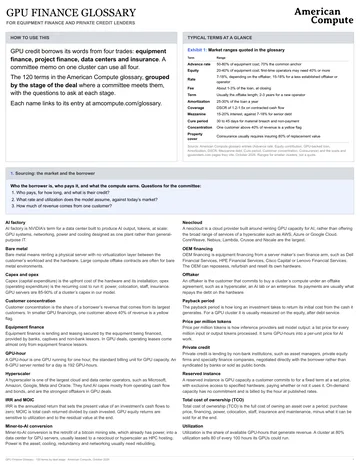
GPU finance glossary
All 120 terms on a six-page PDF, grouped by deal stage from sourcing to workout, with the questions to ask at each stage.
Free PDF
Discuss a transaction
Send us the equipment list and the loan or lease you have in mind. We will come back with an indication and the questions we would need answered.
Prefer email? hello@amcompute.com